When you take a look at the high-speed broadband offerings here in Central Illinois, it’s easy to see the digital divide that exists between our communities and communities in larger markets. In large markets like Chicago, it’s possible for an organization to get high-speed broadband connectivity that’s hundreds of times faster than what’s available here in Central Illinois. Also, the cost of service for us here is often several hundred times more than the same service in these larger market. The reason behind this is simple; we don't have the same access to the fiber-optic highway that larger markets use for their connectivity. As a result, for many communities in Central Illinois, broadband service is inadequate in coverage, short on capacity, and high on price.
Obviously, there's a need to create a new network infrastructure in Central Illinois to provide high-speed Internet connectivity and help narrow this digital divide.
This is where the idea for CIRBN was born.
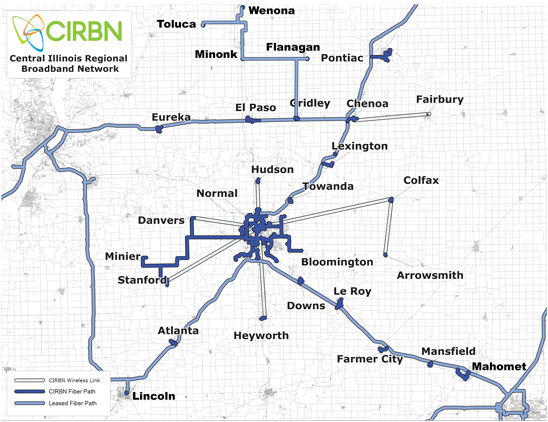
Central Illinois Regional Broadband Network (CIRBN) will provide high-speed, low-cost Internet connectivity to 19 communities in 6 different counties throughout Central Illinois. CIRBN is a collaborative effort, with funding being provided by a combination of federal and state grants as well as private contributions. We are currently building a state-of-the-art fiber optic "backbone" to help bridge this digital divide, help level the playing field, and to deliver much-needed high speed broadband connectivity to many of our communities. Over the next 18 months, CIRBN will be building a fiber-optic network that will link K-12 school districts, healthcare, public safety, government, not-for-profit, and commercial institutions across Central Illinois.
Our construction is starting now and CIRBN will be live beginning August 2013. Be sure and check back often, as we’ll be updating our site regularly to make sure you have the most current information available. While you’re here, check in on our progress, sign up for our newsletter, learn more about what CIRBN means for our community, and send us feedback to let us know what you think!
There are a number of education, health care, public safety, government, not-for-profit, and commercial entities located in various suburban, rural, un-served, and underserved markets in the greater McLean County region and surrounding communities that struggle with the high cost and low throughput of commercially available Internet connectivity.
Central Illinois Regional Broadband Network (CIRBN) will be able to connect their facilities at speeds of 1Gb/s to the various rural community networks or the Bloomington-Normal backbone network.
CIRBN will drive down the cost of building high-speed networks. At the same time, CIRBN will leverage connectivity to a regional optical network and the state network to purchase commodity Internet services in bulk driving down the per-unit cost of Internet connectivity.
By installing nearly 100 miles of intra-community fiber cable, CIRBN will make it easier to deliver broadband service, improve access to education and healthcare services, and help boost economic development to rural, remote, and underserved areas.
How will we do it? Great question!
There are 5 major steps in the CIRBN Project:
1. Bloomington-Normal: The first step involves the creation of a high-speed dark fiber based network infrastructure within Bloomington-Normal. This network will be based on a 10Gb/s ring that will provide 1Gb/s of interconnectivity to more than135 different facilities, with the potential to add more later on. This infrastructure will serve as the “backbone” for CIRBN.
2. Rural Communities: The second step involves the creation of a number of rural community network segments. These will be based upon a dark fiber infrastructure, similar to the one we’re creating for Bloomington/Normal. This structure will provide 1Gb/s of connectivity for communities including Atlanta, Arrowsmith, Colfax, Danvers, Downs, El Paso, Eureka, Farmer City, Gridley, Hudson, Heyworth, Lexington, Mansfield, Pontiac, and Towanda. The creation of these community networks will connect over 100 facilities and will connect even more in the future.
3. Backhaul Circuits: The third component of the project involves how we’ll connect these rural communities to the “backbone” network residing in Bloomington/Normal. This will be done using backhaul circuits and involves using a combination of dark fiber, leased fiber, and wireless bridged circuits ranging in speed from 200Mb/s to 10Gb/s. The type of backhaul circuit used will depending upon cost, availability, and the needs of each rural community.
4. Internet Connectivity: The fourth component is connectivity for this combined network to the commodity Internet at speeds up to 10Gb/s, the state network, and various research networks up to 1Gb/s so that organizations residing within the Bloomington-Normal and rural communities will have high-speed access to local, regional, state, national, and international resources. This connectivity is provided through the backbone network that will be created in Bloomington-Normal.
5. Residential Broadband: Finally, the fifth component involves partnering with commercial providers to extend broadband services to rural and suburban consumers. This partnership would make it possible for the service provider to offer affordable broadband service in these markets while contributing to the sustainability of CIRBN. Currently, discussions are taking place about how to leverage the CIRBN infrastructure to deliver residential broadband services into rural markets that prior to the creation of this network were financially impractical to offer.
CIRBN was made possible through the ARRA BTOP initiative, but the idea to create greater access in Central Illinois was concept already on the minds of area leaders.
Since 2004, the Economic Development Council (EDC) of the Bloomington-Normal area held talks and conducted the studies about constructing a broadband network in Central Illinois. Though there was interest and studies pointed out many benefits, without strong financial support the network could not yet become a reality.
The next discussions took place between Illinois State University (ISU) and K–12 schools in McLean County. School districts needed more capacity at a lower per-unit cost. Districts connected to the regional POP for the Illinois Century Network (ICN) hosted by ISU. This POP services a number of counties in Central Illinois.
While focusing on the issues with the K–12 schools, Illinois State was approached by Heartland Community College (HCC) and the Town of Normal about their own needs. Both entities had the same connectivity issues when trying to access the local ICN POP. These discussions suggested the effort should be expanded.
Seeing the possibility for BTOP grant funding, ISU worked with HCC to host a meeting on creating a regional network in July 2009. More than 40 organizations, including higher education institutions, K–12s, municipal entities, local healthcare organizations, a local Internet service provider, and a nonprofit from the surrounding area attended. Public response supported creating a proposal to develop an application for BTOP.
Led by Illinois State University, a group of 10 technical and financial planners from six different organizations worked from August 2009 to March 2010 to develop a proposal for the second round of BTOP awards. The scope was defined as any public or private sector organization that could be reached with a fiber-optic infrastructure. This process resulted in the creation of CIRBN (Central Illinois Regional Broadband Network).
As the CIRBN team was approaching the BTOP due date, it was approached by the ICN to partner on this grant. The result was the IBOP-EC (Illinois Broadband Opportunity Program–East Central). IBOP-EC took CIRBN’s focus on community networks and the ICN’s focus on high-speed connectivity between communities and combined them into a single application. The creation of IBOP-EC also allowed the CIRBN proposal to secure state of Illinois matching funds for 20 percent of the total project budget. The combined application was submitted covering 55 counties with a total project budget of $96 million (of which CIRBN represented $17.6 million).
Another benefit to joining the IBOP-EC partnership was that CIRBN could focus more on communities and organizations and less on backhaul connections. By time IBOP-EC BTOP application was submitted to the NTIA, CIRBN had secured nearly 50 partners who have agreed to provide cash matches and had identified nearly 250 CAIs in six counties. The partners collectively provided more than $500,000 to support the initiative
Ultimately, the ARRA BTOP program funded more than $300 million worth of broadband projects in Illinois. The state of Illinois provided more than $50 million in capital funds to match.
Although CIRBN is a unique effort in Central Illinois, it is one of many projects within the state. Illinois State University is one of three public universities within the state, including NIU and UIUC, to receive federal funding to create regional broadband networks. These projects and the IBOP-EC effort will be historically significant as our population continues to develop dependence upon high-speed connectivity and uses it to compete more effectively throughout the nation and across the globe.
Over the next three years, CIRBN will construct approximately 80 miles of new fiber optic cable throughout Central Illinois. Construction will encompass six counties, 19 communities, and include more than 100 partners such as K–12 schools, community colleges, major universities, public safety organizations, municipal offices, libraries, and healthcare facilities.
Project timeline
July 2009—Broadband planning group
August 2009—CIRBN Grant Proposal group begins
March 2010—CIRBN and CMS proposals combined
March 2010—IBOP-EC grant submitted
August 2010—IBOP-EC grant awarded
February 2012—CIRBN construction begins in Hudson
March 2012—Construction begins in Danvers
March 2012—Construction begins in Downs
March 2012—Construction begins in Farmer City
April 2012—Construction begins in Heyworth
April 2012—Construction begins in LeRoy